Alone
A QNT moves a voltage onto the nearest note of a scale you choose. A new QNT is a keyboard with C major lit: the lit keys are white, the rest dark. The dark keys are not a piano's black keys but keys out of the scale, and any of them lights like the others: click Eb and it turns white. Click a key, or drag across several, to light or clear them.
A voltage at IN comes out at OUT on the nearest lit key, 1 V per octave. Patch a random voltage or a slow LFO into IN and OUT is a melody in the lit scale. With IN empty, OUT gives the lit keys as a chord, one channel per key, from C4 up. If more than sixteen keys are lit, the lowest sixteen sound.
The QNT knows only which keys are lit, not which one is the root. D dorian is the notes of C major, so a new QNT already plays it; to stress D, the melody coming in must.


- Arrows the next variant, shown under the pointer
- Transpose drag to move the notes
- ° lit, transpose by degrees; dark, by semitones
- Dark key out of the scale
- White key in the scale; click or drag across to change
- IN the voltage to quantize
- OUT quantized, or the scale as a chord
Transpose, by degrees or semitones
Drag the top screen to transpose. The small ° beside it chooses how: lit, the default, by degrees of the scale; dark, by semitones. In degrees every note moves along the scale and the keys stay as set: in C major, one degree up turns a C into a D and an E into an F. In semitones every note moves by the same interval: the lit keys stay where they are, and the letters on them change to the notes they now play.
The QNT has no jack for transpose, and nothing transposes its own OUT by voltage. Over CV faders, an ATN does it for the faders: see Quantizing CV faders below.
Rotate the scale
⌘*-drag over the keys to move the lit pattern round the octave a semitone at a time, so the same intervals start on another key: C major moved up two keys is D major. While you drag, a readout names the scale the keys now make.
Microtonal detune
Shift+⌘-drag on a key detunes that key alone, up to 99 cents either way.
Octaves
Shift-drag over the keys adds or removes octaves, from one to ten. Each octave added is twelve more keys to light, and the whole pattern repeats above and below them. The chord at OUT is every lit key across all the octaves, from C4 up.
Three variants
While the pointer is over a QNT, arrows appear either side of its title; click one for the next variant. Each variant keeps its own settings, so stepping away loses nothing. QNTs standing side by side change variant together.




The piano roll
The roll's notes light as the keyboard's keys do, and its transpose moves every note it sounds by semitones, the drawing staying as set; the Shortcuts below list its drags. With IN empty, OUT plays the lit notes as a chord, each in the octave where it is drawn.
The volt divider
Drag the top screen for the number of parts, up to 255. A new divider stands at 0 parts, which quantizes nothing: the voltage passes untouched. That is also a way to stop a QNT quantizing without taking it out of a rig.
For N notes per octave, set ten times N: 120 for twelve-tone, 190 for nineteen. The parts divide 10 V, not an octave, so twelve parts are 0.83 V each, not semitones.
With N parts, lines stand 10/N V apart, from 0 V up and down. A voltage drops to the line at or below it, and below 0 V rises to the line at or above it. It does not go to the nearer line as the keyboard does, so a voltage a hair under a line falls a whole part.
The large screen below the number sets the spacing: equal by default, bent toward exp or log by a drag. Past log it switches to the harmonic series from C4. Shift-drag snaps to each of those, and a double-click goes back to equal. With IN empty, OUT gives the lines from 0 V up as a chord, the first sixteen.
Bonded
Quantizing CV faders
Place a QNT to the left of CV faders standing side by side, and the faders show note names and land on its lit keys. Transpose the QNT and they all move. While a SEQ plays the faders, the key of the note sounding lights in the SEQ's colour: in the picture, C, under the playhead.
A QNT acts only on what stands to its right, and reaches only the first block of CVs there; a later block of CVs with no QNT of its own plays the same way (How rigs work). If several QNTs stand side by side to the left of the CVs, the rightmost one sets their scale and the others give only their own OUT. ⌘-drag on the top screen transposes all of them together.
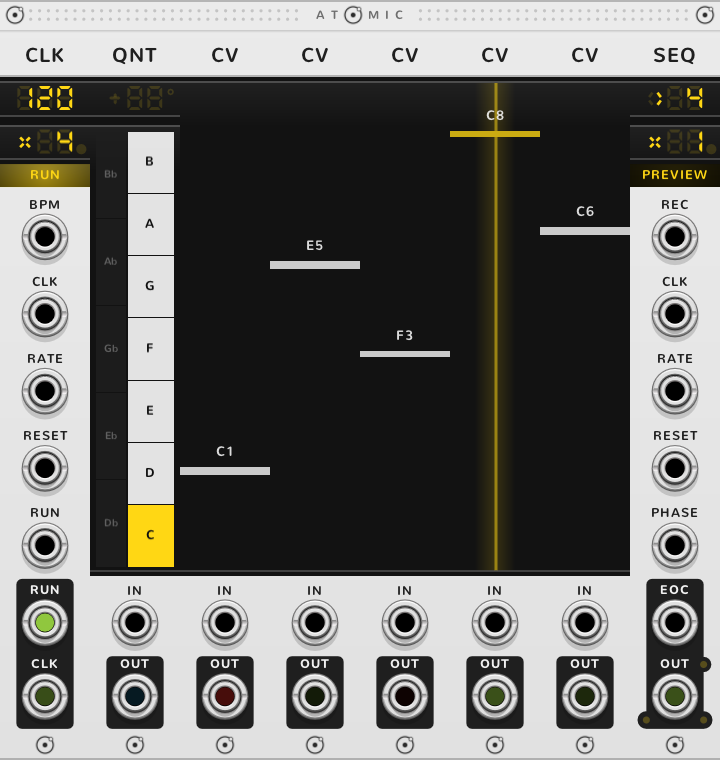
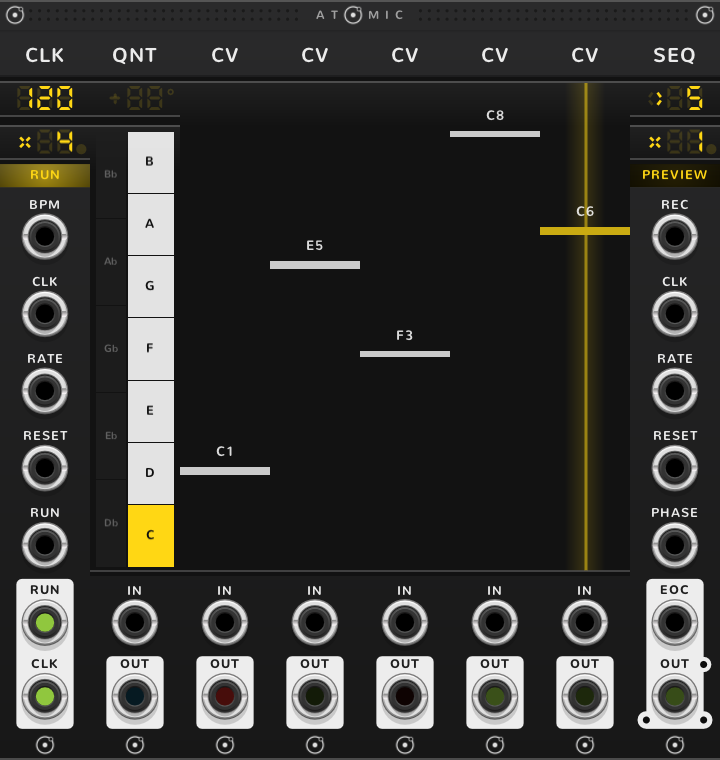
An ATN in front of the faders, on either side of the QNT, does two jobs for them at once: its gain sets how wide a span of notes the faders reach, and its offset transposes them along the scale. A voltage at the ATN's + jack adds to that offset, 1 V per octave, counted in semitones and moved to the nearest step the scale holds, the upper one at a tie: in C major 1/12 V and 2/12 V both move every fader's note one step along the scale. The ATN changes only the faders; the QNT's own OUT stays as it was.
Chord sequences
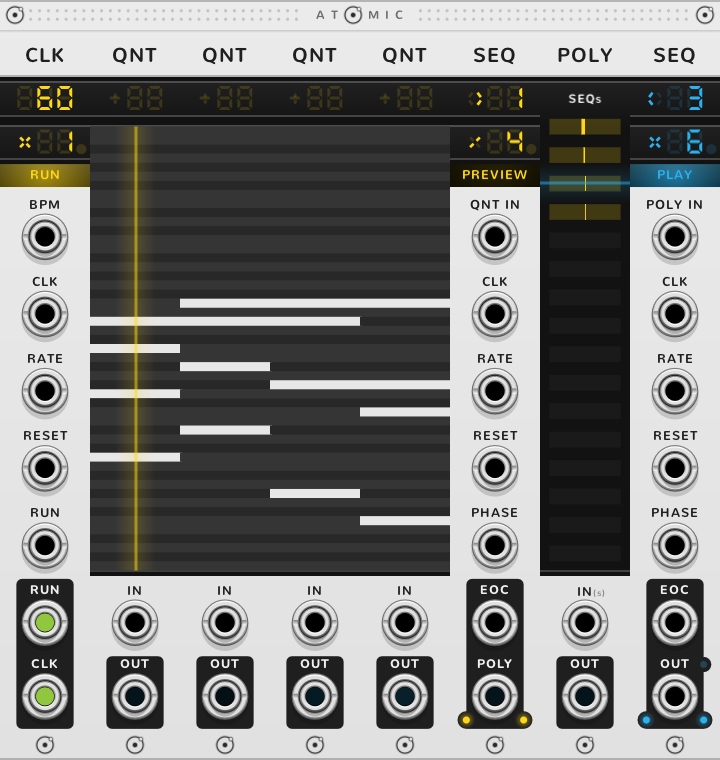
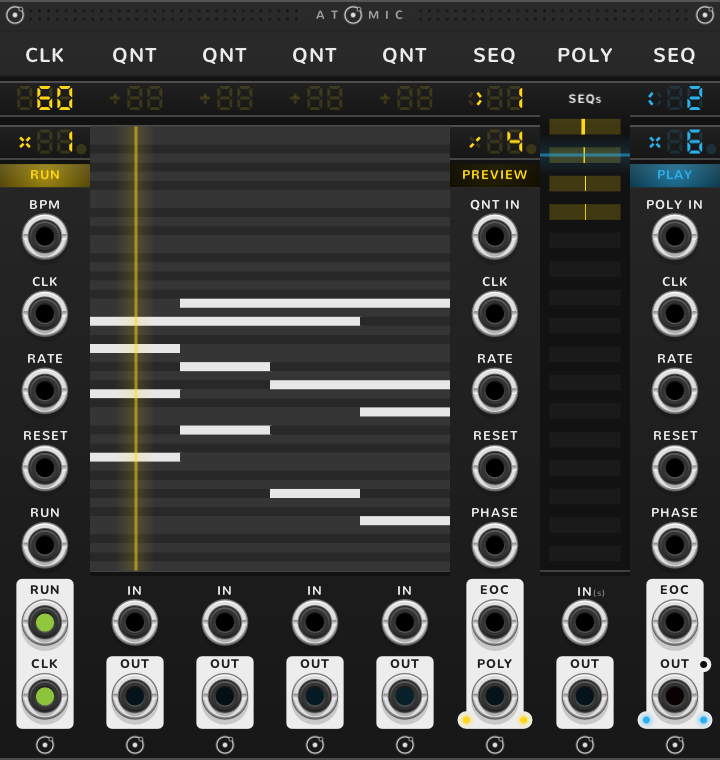
QNTs side by side can also be a SEQ's steps. A SEQ to their right plays one QNT per step, each a scale or a chord: draw a chord in each roll and the SEQ walks a progression, the chord of the step playing coming out of the SEQ's bottom jack.
The SEQ names its jacks by what it steps through. Over CVs its top jack reads REC; over QNTs it reads QNT IN, and a voltage there is quantized by the QNT under the playhead and comes out of the bottom jack instead of the chord. The bottom jack reads OUT while it carries one note and POLY while it carries a chord.
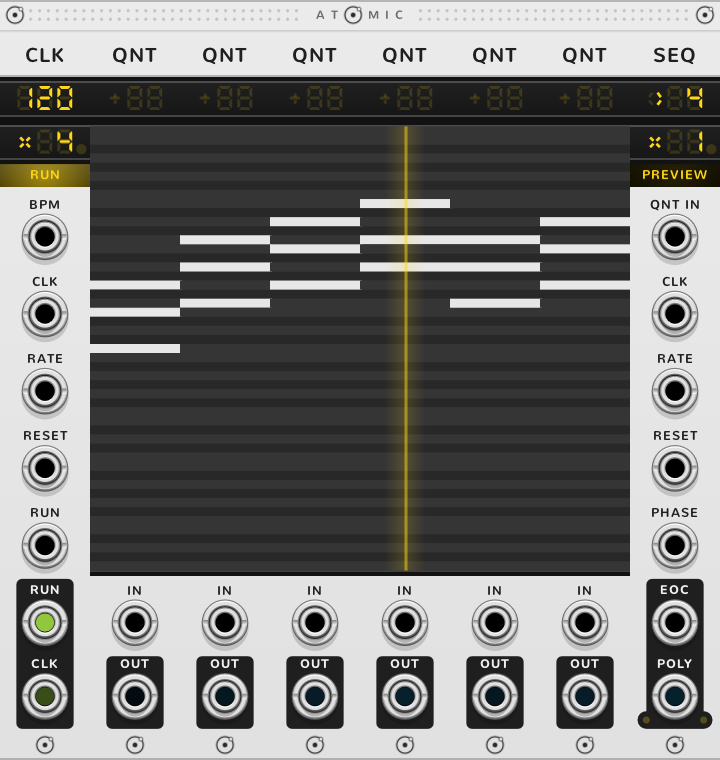
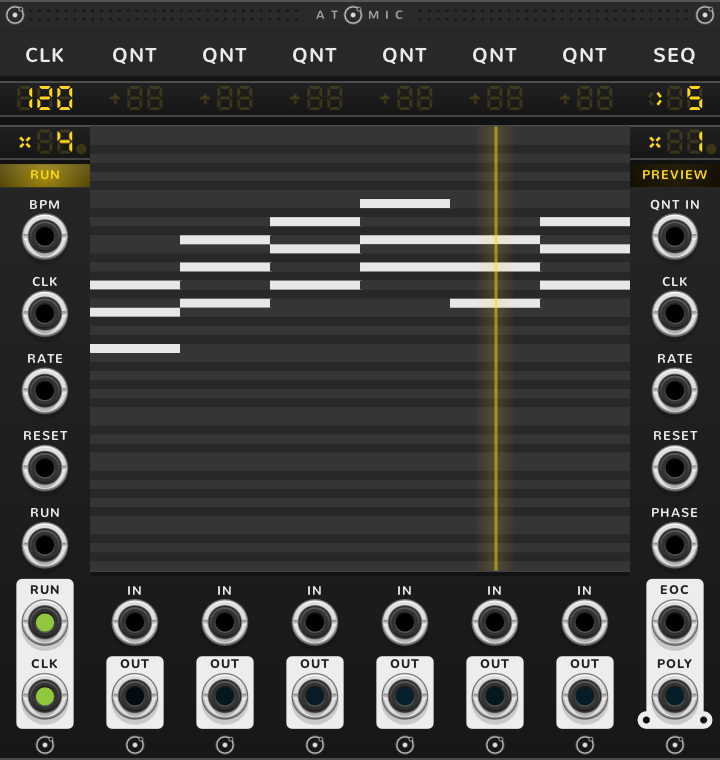
To play a chord as an arpeggio, patch a QNT's OUT into a lone SEQ's POLY IN. In a rig, bond a POLY and a second SEQ to the right of the first: the POLY takes the chord of the step playing, and the second SEQ plays its notes one at a time, with no cable.
Shortcuts
| Where | Gesture | What it does |
|---|---|---|
| Title | Click an arrow | the next variant |
| Transpose | Drag | transpose |
| Transpose | Shift-drag | transpose by octaves |
| Transpose, in a rig | ⌘-drag | transpose every QNT side by side with this one |
| Transpose, in a rig | ⌘-double-click | reset the transpose of those QNTs |
| ° | Click | semitones or degrees |
| Keys | Drag across | light or clear the keys |
| Keys | Shift-drag | add or remove octaves |
| Keys | ⌘-drag | rotate the scale |
| Keys | Shift+⌘-drag | detune this key |
| Roll | Drag across | light or clear the notes |
| Roll | Shift-drag | add or remove octaves |
| Roll | ⌘-drag | move the notes |
| Roll | Shift+⌘-drag | scroll the roll |
| Parts (divider) | Drag | the number of parts; 0 passes the voltage untouched |
| Spacing (divider) | Drag | spacing, up to log and the harmonics |
| Spacing (divider) | Shift-drag | snap to exp, log or harmonics |
| Spacing (divider) | ⌘-drag | fine |
On every module
| Where | Gesture | What it does |
|---|---|---|
| A value on a screen | Double-click | back to its default |
| Any part | Rest the pointer | a tooltip explains it |
| A module's title | Hold ⌘ or Alt | the Atomic menu: change this module into another kind, or insert one beside it |
| The Atomic menu | Shift+⌘-click | delete the module |
| The bracket | Delete | remove the whole rig |
| The bracket | ⌘-D or Alt-D | duplicate the rig; with Shift, its cables too |
| ATOMIC on the bracket | Click | it reads RESET under the pointer, and starts every SEQ and CLK of the rig again |
* ⌘ is Ctrl on Windows and Linux.