Alone
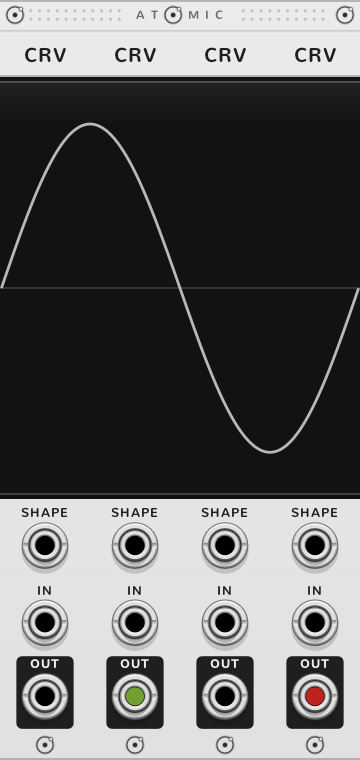
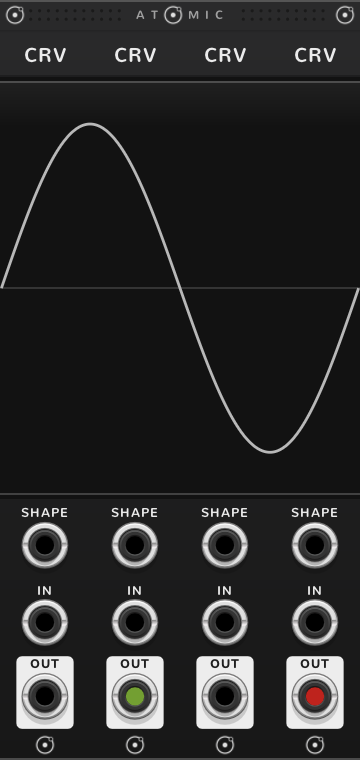
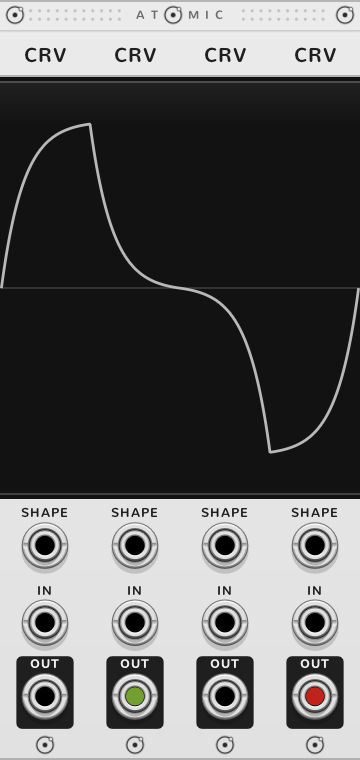
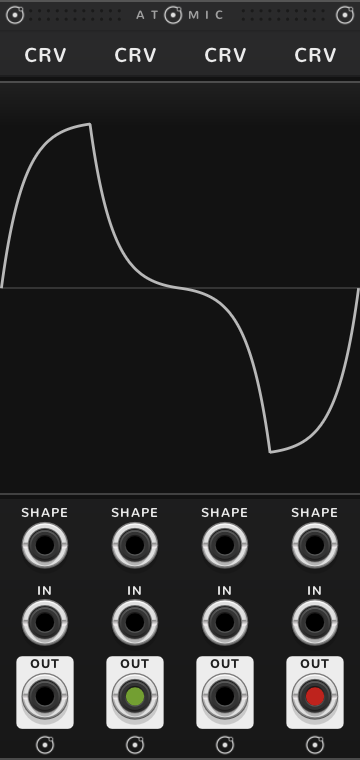
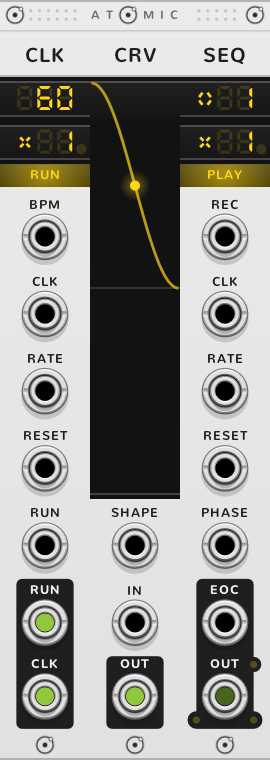
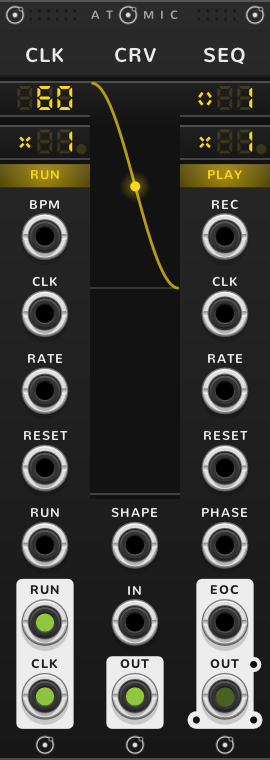
A CRV holds a curve from a start point to an end point. IN picks a point along it, -10 V at the start and +10 V at the end, and OUT gives the curve's height there. With IN empty, OUT gives the start: a new CRV runs from +10 V down to -10 V, so it gives +10 V. A slow ramp at IN traces the shape over time; an audio signal at IN is waveshaped by it. A poly cable at IN gives a poly OUT, each channel through the same curve.


- Start drag up or down in the left third of the screen
- Shape drag in the middle third to bend the curve
- End drag up or down in the right third
- SHAPE replaces the shape: -10 V the deepest sag, +10 V the widest bulge
- IN the point along the curve, -10 V to +10 V
- OUT the curve's height there, or the start with IN empty
The start and end run from -10 V to +10 V. The shape runs from -10 to +10, the same numbers SHAPE takes in volts. At 0 the curve is a straight line; below 0 it sags, above 0 it bulges. On a rising curve a sag is exponential, slow then fast, and a bulge logarithmic. At ±10 the steep end climbs about ten times as fast as the straight line.




Bonded
Atomic modules pushed edge to edge bond into one rig.
A row of CRVs
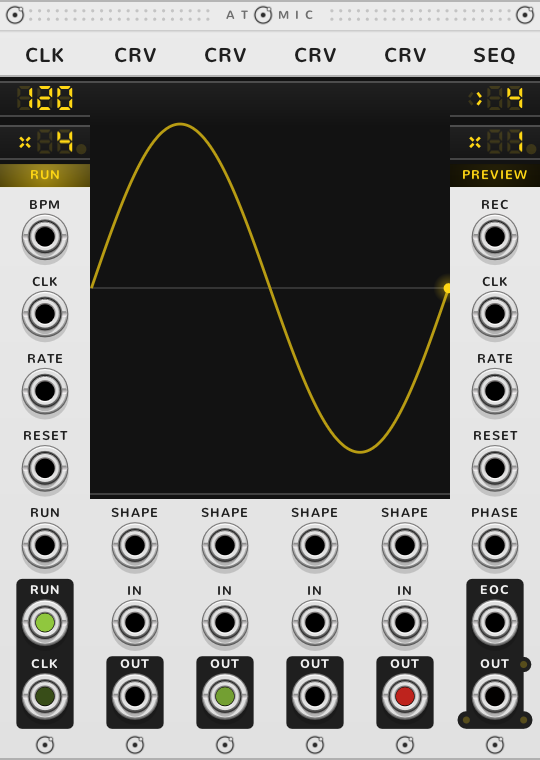
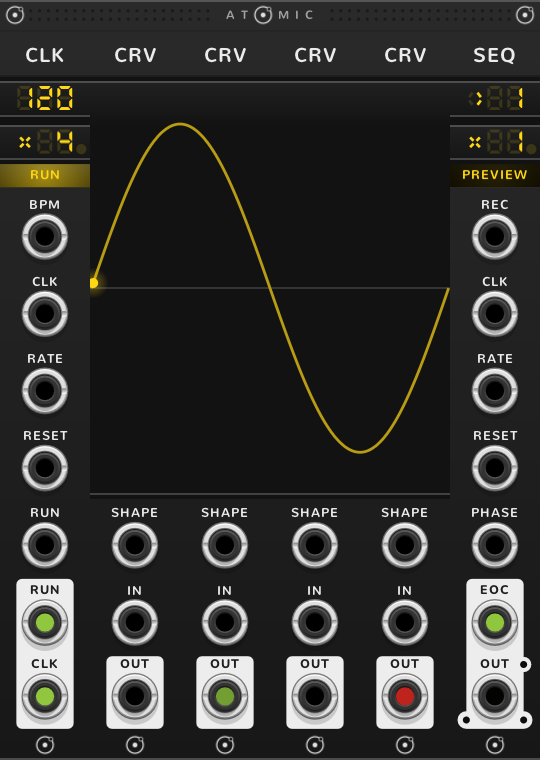
CRVs side by side draw one curve, a segment each. In a row, or stepped by a SEQ, IN and OUT change job: IN sets this CRV's start point by voltage, within its range, and OUT gives that start as a steady voltage. The curve itself plays at the SEQ's OUT.
Double-click a start to join it to the end of the CRV before; double-click an end to join it to the next start. A joined point moves as one; double-click it to split it again. To close the row into a loop, double-click the first CRV's start, or the last CRV's end: the two join round, so the curve ends where it began.
Each segment is bent or a spline; double-click the middle of a segment to switch it. A bent segment curves on its own, between its two points, as a CRV alone does. Joined splines make one smooth curve through all their points. On a spline the shape sets the tension: -10 pulls it straight, +10 rounds it out, and 0 is in between. SHAPE sets the tension the same way.
Stepped by a SEQ
With a SEQ to the right of the row, each CRV is one of its steps, and the SEQ's OUT plays that CRV's whole curve from start to end across the step. The SEQ takes one step per tick of its clock, so a CRV lasts one tick: with a CLK at 120 BPM and its rate at x4, a sixteenth note.
One CRV makes an LFO. Set the SEQ's direction to pendulum and it plays the curve forward on one tick and back on the next, with no jump. Played forward only, a rising curve jumps back to its start each tick, which makes a saw. A row of CRVs joined round is an LFO of any shape you draw, its cycle as many ticks as there are CRVs.
An envelope
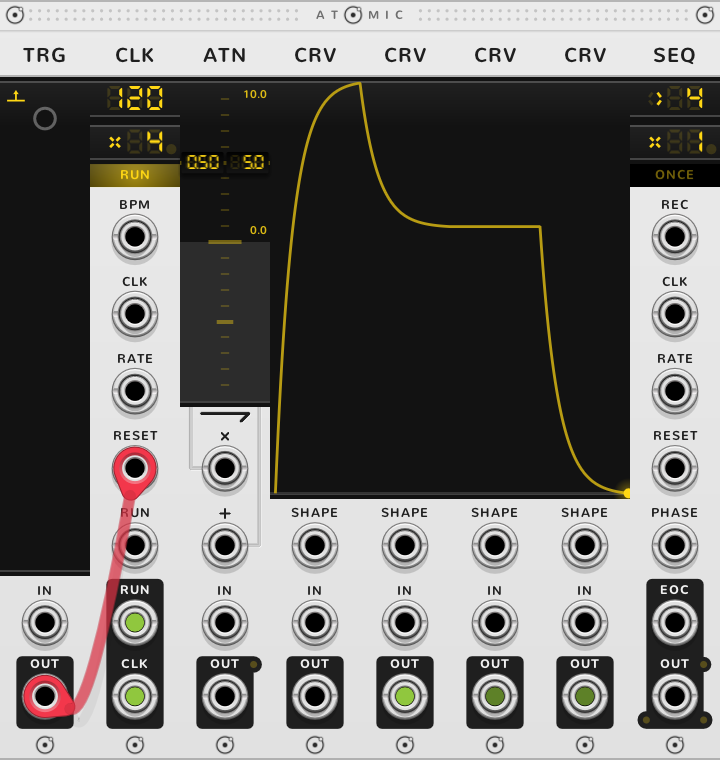
Draw the envelope across a row of CRVs, a segment each, and set the SEQ's mode to ONCE: it plays the row once, then stays at the end of the last CRV, so OUT holds that last end point until the next pass. Every CRV lasts one tick, so a stage that should last longer takes more CRVs, and a slower CLK rate stretches the whole envelope. The sustain lasts as many ticks as its CRVs; no gate holds it.
To fire it, send a trigger into the RESET of the CLK bonded on the left: the SEQ goes back to step one at once and plays the envelope again. That RESET restarts every other SEQ the CLK drives too, as the CLK guide says.
A range from an ATN
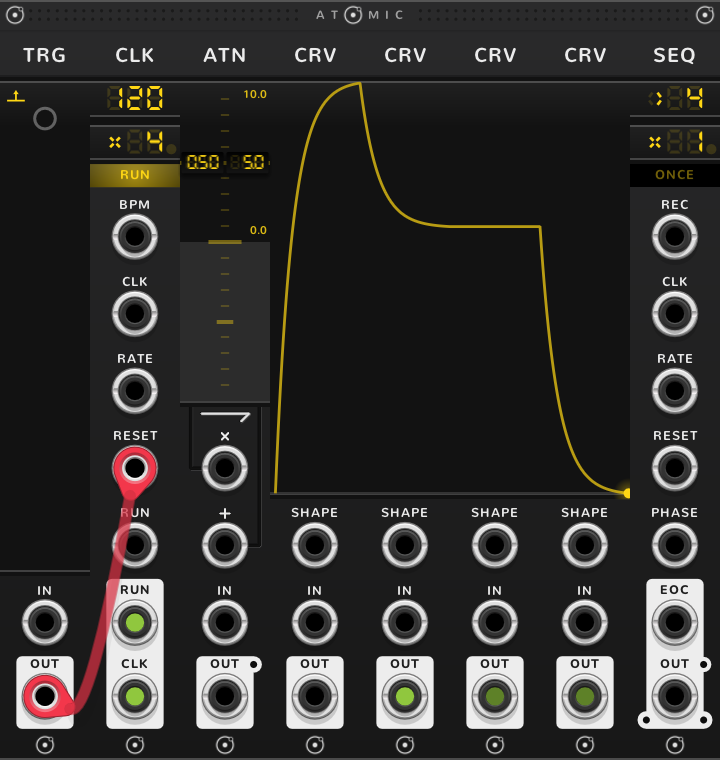
IN reads -10 V as the start, so a 0 to 10 V ramp plays only the second half of the curve. Bond an ATN to the CRV's left, its right arrow lit, and set a gain of 0.5 and an offset of 5 V, a range of 0 to 10 V: IN then reads 0 V as the start and 10 V as the end, and the start and end points move within 0 to 10 V too. A CRV with only an ATN beside it is not in a row, so its IN still reads along the curve. An ATN to the left of a row sets the range of the whole row.
A function of one voltage
To map a voltage through a whole row, set the SEQ to HALT, double-click its step to put it on step one, and patch the voltage into its PHASE: 0 to 10 V then sweeps the row from the first start to the last end, and the SEQ's OUT gives the curve there. PHASE counts from the step on the SEQ's screen, so on any other step the sweep starts part way along the row.
Shortcuts
| Where | Gesture | What it does |
|---|---|---|
| Start, end | Drag | the point |
| Start | Double-click | join to the end before, or split; on the first CRV, join round to the last end |
| End | Double-click | join to the next start, or split; on the last CRV, join round to the first start |
| Start, end | ⌘*-double-click | join or split every touching CRV |
| Start, end | ⌘-drag | scale the touching starts, or ends |
| Start, end | Shift-drag | on whole volts |
| Start, end | Shift+⌘-drag | match the touching starts, or ends |
| Shape | Drag | the shape |
| Shape | Double-click | bent or spline |
| Shape | ⌘-drag | move the touching shapes |
| Shape | ⌘-double-click | make the touching CRVs splines, or bent |
| Shape | Shift-drag | on whole numbers |
| Shape | Shift+⌘-drag | match the touching shapes |
On every module
| Where | Gesture | What it does |
|---|---|---|
| A value on a screen | Double-click | back to its default |
| Any part | Rest the pointer | a tooltip explains it |
| A module's title | Hold ⌘ or Alt | the Atomic menu: change this module into another kind, or insert one beside it |
| The Atomic menu | Shift+⌘-click | delete the module |
| The bracket | Delete | remove the whole rig |
| The bracket | ⌘-D or Alt-D | duplicate the rig; with Shift, its cables too |
| ATOMIC on the bracket | Click | it reads RESET under the pointer, and starts every SEQ and CLK of the rig again |
* ⌘ is Ctrl on Windows and Linux.